|
No, that was not the reason. Yes, I had started spelling most words right. The essays were returning with fewer remarks in red. Thanks to Phantom the Ghost Who Walks, and Mandrake the Magician, I was getting more and more comfortable reading English. The reason why I was enrolled in the typing class, to get my fingers mapped to asdfgf ;lkjhj, was the parental belief that proficiency in typewriting would give me a better chance of landing a bank job. It helped that I did try my hand often on my father’s vintage Remington at home. I would manage to punch out a draft using just two fingers with minimum use of the corrective x and triumphantly pull out the paper. TypereporterEventually, when a bank did employ me, I could not use the machine because typists were an altogether different species. And you don’t need the machine to affix rubber stamps on documents before filing those away. Even after the bank moved me to their house magazine department, where they possibly expected me to do more work and less harm, I ended up doing more writing, but the typing tools were handled by others. Then came the stint with a newspaper where I was virtually married to a typewriter, at least the one which was available and not in use by a fellow reporter. It took me a while to gain enough confidence to bang out a report without writing it out by hand first. Those days the sub-eds were very demanding. One day, the most meticulous of them emerged from their room (strategically walled away from the reporters) holding my report in hand. He loudly congratulated me because the report had no xxx (corrections) and did not need editing. It is a different story that the sub-editor had his gaze fixed on another senior colleague while he was shouting out his congratulations. This senior had made it a habit to liberally use the x-key as a loud eraser of sorts. Of course, I lost a fellow reporter friend that day, but I hugged my best friend, the typewriter. Corporate scribeThe next job took me to a corporate office where the typists grudgingly accommodated me during the initial days. The secretarial murmurs must have reached the boss, because one day he walked in with a portable typewriter. That became my primary tool. Then the revolution happened. Computer! The bulky contraption that could do magic. It got a cabin for itself (the mere humans outside did not need air-conditioned comfort). Soon I was learning to juggle large OS and data floppies. WordStar welcomed me to the digital era of writing. But not before teaching me an important lesson. If you switch off the computer because it is lunch time and you are too hungry to remember to save the document first, you will come back to zilch. The computer made it easy to create and alter reports. I could focus on harvesting stories—from the starched-straight address of the CEO to the hesitant confession of the retiring peon that he had told a little lie all those decades ago that he could ride a bicycle. Just to get the job. Then came one software after another. It was intoxicating. It was no longer enough for me to write. Corel had to draw magic to convert a simple word into what I proudly thought to be visually dashing. PageMaker could churn out page after page, with the text seamlessly flowing from one column to another, even jumping across pages. I was hooked and lost. Until the day the boss gently told me to close the cabin door after taking one look at a simple draft that I had chiselled to perfection using every software I could access. This was ominous because the boss had no qualms about praising a draft he liked, with not just the cabin but also everyone's ears open. “Are you sure this is what you want to do?” I could sense he was close to an explosion. “We employed you to talk to people and write what they say in a manner that the readers can appreciate. We want you to understand the purpose, match the occasion and do an effective job of communicating. Which I thought you were doing well, at least so far. Now, you are lost in all this fancy software!" I tried to mumble that these were modern tools and I was just trying to keep up with the times. "Exactly!" he continued. "Good tools, no doubt. Must be used when necessary to get your point across more effectively. But not because you can or because others are using these. If you want to surrender to the trend, why not leave and start a DTP shop? Then you just have to design and print. You don’t have to bother to really write.” That was my wake-up call. Enter the entrefluencepreneurFast forward to the present for a more recent wake-up call. I had shared an important document after spending long hours with the boss and her senior colleagues. This was set to define the client's positioning in an increasingly crowded market and what they had to offer their target segment. I thought it was important to capture the values that made them uniquely human while reels roiled the social world. I requested them to put their heads together before we finalised it. After several days came the response from someone new, who described himself as entrefluencepreneur, someone who knew "viral secrets", as he put it modestly. “Please share the document again with keyword lists and classification to create backlinks.” Then he went on to spew more techjargon like SEO, backlinks, meta descriptions, title tags, alt attributes, etc. Everything except what we were supposed to focus on. Of course, he was in a rush. Yet, I asked a couple of questions in response. Do we jump into intelligent technology and let it decide what we want to say and how? Or do we first gain clarity on who we are, why we are unique and our value proposition before we rush out and do whatever it takes to catch the eyes of whichever engine? Say we succeed and the traffic pours in, is that what we want? How are we then different from the noisemakers? Or we don’t want to be different? Obviously, the assignment did not come back. I missed the old boss. He would have probably responded: “Are you sure you don’t want to open an AI shop? You won’t even need an actual shop. Talk to your laptop or mobile and it will instantly give you what you want. You don’t have to bother writing it. Forget writing, you won’t need to think either.” You were right, boss. What you told me way back when the only type of intelligence available was human. Yes, I miss the typewriter. It used to wait for me, cover off, paper loaded, an efficient tool. However, the thinking before I tapped a key had to be all mine, always. It did not rob me of my human intelligence even if I was willing to surrender. And, as you said, all I have to do is use another tool to fill the gap in execution, that the typewriter can't readily fill. Use the tool, without letting it take you over.
6 Comments
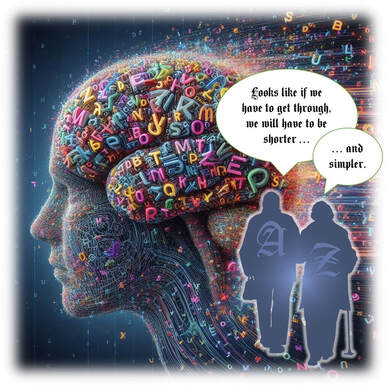
How to write right? I put that question to her. She is a wiser, older writer, who never misses an opportunity to tell me between the two of us she is always “righter”. “In what you do, what is right writing is what your client says is right,” she banged her fist on her palm, as was her habit if there was no table within reach. As Messrs. Wren, Martin and Roget had played a major role in shaping two of my three R’s, it was not easy to accept her assertion. Yet, she did have a point. Long ago, when covid would have probably been highlighted as a spelling mistake, I was surprised by a call from Hong Kong. That was my first overseas client happy to have me WFH (another spelling glitch then). We worked happily for about two years. One day, he abruptly told me the boss was not happy with my writing. “Too direct, almost impolite.” Soon, they moved on and he (now a friend working elsewhere) revealed that the boss had changed—the American was replaced by someone from the UK. Was it just a matter of the difference in nationality? Could we have solved it simply by UK-ing US English? Apparently, there was a change in temperament too. Conclusion: You may spend hours sharpening it, but a change in nationality and personality can snap the lead, just like that! Now I am quite used to both extremes. “Your writing is too simple. Can we have some strong words?” “Your writing is too complex. Please simplify.” I simply comply. When writing is your work, write what works. A new book, Writing for Busy Readers, reviews The Economist, has very simple advice: cut unnecessary words, stick to “bedrock vocabulary” and follow simple syntax. The book goes on to give proof of the preaching. Simply deleting half of the paragraphs in a fundraising email increased donations by 16%. Reducing the words from 127 to 49 in an emailed survey increased the response rate from 2.7% to 4.8%. Public companies that used long sentences and complicated words to state their ethics code were seen as less moral and trustworthy. Phew! Short and sweet it has to be then? What happens when the first-level contact at the client’s throws your content on the scale to weigh the “content”? How many are fortunate enough to deal directly with the would-be author to understand them and their authentic tone well enough to make the draft a “good to go” at the very first instance? Of course, without interference from chatty intermediaries and GPT! Short, easy words definitely have their place but not for all. This “sesquipedalian” Member of Parliament (MP) is known less for what he says than for the words he uses to say that, whether you understand or not be damned. That’s his brand, what has made him famous. An old friend, an ageless writer and veteran communications professional, had the opportunity to compliment this MP after the latter had addressed a gathering. “Thank you for elevating this discussion to crepuscular altitude and suffusing it with intellect of refulgent luminosity.” Incidentally, this friend’s first book will be published soon. When he told me about it, I suggested he should title it Condiment-laden Camellia sinensis decoction for the neshama. He refused. Must be the influence of the new wave. He has given it a title all too simple and short: Masala chai for the soul. |
AuthorVijayakumar Kotteri Categories
All
Archives
April 2026
|
RSS Feed